Insights: The Power of Youth Leadership
The Power of Youth Leadership roundtable brought together stories that explored how real change happens when power is shared with young people, where leadership comes from and who gets to lead. From Henrietta’s journey through the care system to advocacy, Alex’s peer-led anti-bullying campaign that sparked a national movement, to Samuel becoming a CEO at just 22 — each story proved that young people can lead with lived experience. Real change is possible when power is shared. Leadership thrives where trust, time, and listening are all present.
Read and download the key insights from the roundtable discussion:
The following sections delve deeper into some of the key learnings from the round table.
Who Gets to Be a Leader?

A thread running through the discussion was the challenge to traditional assumptions about leadership. Speakers consistently pointed out that leadership is not bestowed by institutions, but that it emerges from lived experience, creativity, and community insight.
Henrietta Imoreh: Leadership Through Lived Experience
Henri’s project, Redefine, used theatre to support young people in care, grounded in her own experience of instability within the foster system. For her, the arts weren’t a hobby, but a survival tool. Henri found The Agency methodology offered something she had never been given by social services: power, ownership and accountability.
“I entered The Agency lacking confidence, tools and stability. Receiving funding gave me power for the first time, the power over my story, my project, and how I wanted to create change.”
The shift was not symbolic. The agency of decision-making enabled Henri to step into advocacy, carrying her work into Parliament and contributing towards the national Independent Review of Children’s Social Care.
Her leadership journey raised a central question: How do we give young people real power?
She spoke about the support she got from Battersea Arts Centre, when joining the board, as central to helping build her confidence in a governance role. A confidence she is bringing to her new role on The Agency of Change’s board.
Young People Learning From Each Other
Alex Holmes OBE shared the moment that sparked his now global anti-bullying movement. As a teenager experiencing racism and bullying, he created, the role of student anti-bullying coordinator, and trained other students to take on similar roles without waiting for permission. He distributed surveys during registration, presented findings to school governors, and convinced them to act. There was a disconnect in the school between his own experience and the knowledge and understanding of teachers, who perceived that bullying wasn’t occurring.
Alex said:
"Embed young people's voices at every level of decisions that affect them and really empower them to shape attitudes and change behaviours."
Alex emphasised that schools, where young people spend thousands of hours, are underused laboratories for youth leadership and social action. His story illustrated that young people are not passive beneficiaries; they are analysts, designers and community researchers with deep systemic understanding. His insight: peer-to-peer learning is one of the most powerful drivers of change. His student-led intervention evolved into the Anti-Bullying Ambassadors programme, now in primary and secondary schools across the UK.
Partnerships and Collective Leadership
Samuel Remi-Akinwale, CEO of Young Manchester, shared a parallel insight from becoming a chief executive at 22:

“Young people want better for themselves. The issue isn’t talent, it’s access and belief. Sharing power means teaching young leaders how to wield it.”
Samuel emphasised that leadership is a collective movement. It flourishes when organisations invest time in young people, create safe conditions for experimentation, and commit to ongoing partnership, instead of one-off consultation. Leadership grows when young people, organisations and civic structures build relationships across sectors.
“Partnership is the cornerstone of meaningful community change. It is important to create spaces, opportunities, conditions for organic relationships and collaborations to emerge”
Samuel stressed that many barriers faced by young people are the result of consolidations of power, rigid systems, adult-centric decision-making and structural inflexibility. Breaking these patterns requires organisations to share power intentionally.
These insights underpin the approach The Agency has taken over 13 years in partnership with cultural institutions Battersea Arts Centre, Contact Theatre, Octagon Bolton, Storyhouse, Energise Me, National Theatre Wales and New Lodge Arts, Blackhorse Workshop and Kiln Theatre creating spaces for young people to step in to diverse roles.
Lived Experience to System Change
Zarka’s Story: Leadership Rooted in Belonging
Zarka, a Southampton Peer Mentor, created Sports with Support, a project helping young girls, particularly those navigating religious or cultural barriers to access sport and mental health support. Her pilot drew 50 participants, and after pitching to ActiveMe360, she secured permanent funding.
She now supports the delivery of The Agency with Energise Me in Southampton, as a Peer Mentor, she described her role as:
“I’m like the older sister because I am guiding young people in a way that I wish someone would guide me, And I think it's really beneficial to see someone else's path so you can inspire them.”
This experience demonstrates the importance in cyclical leadership and investing in young people to take paid roles, that continue to enable supported opportunities.
The panel’s stories revealed that systems change often begins with individual acts of agency. Alex reflected on the inclusion of young advisors at the Diana Award:
“Young advisors specifically told us who they needed access to, who they wanted to speak to. And they worked with our board, our staff, to set very clear principles around the way they wanted us to engage them and also how they want to show up…so that the things felt more meaningful.”
These insights pointed towards a deeper truth: Young people aren’t waiting for systems to change, they are already changing systems. Systems simply need to catch up.
“The biggest thing we encourage with the anti-bullying ambassador program is giving young people the ownership and the opportunity to disrupt, tear apart and review some of the systems. ” Alex Holmes
Young people deserve more than Pizza!
Alex said: "You have to pay young people...pizza is not enough. You actually have to pay young people for the work that they're doing that an adult would absolutely be paid for." Young leaders must be compensated fairly for their time and contributions. This principle resonated deeply in the zoom chat, underscoring a wider sector shift towards fair compensation, shared governance and lived-experience expertise.
As part of The Agency programme, we have been paying stipends for young people since 2013. It is our belief that payments remove barriers, and also give value to the contributions and ideas of young people.
Listening, Trust and Shared Power
A principle echoed across the event was simple:
The first step of youth leadership is listening.
Listening not to get information, but to understand lived experience.
Listening not to impose solutions, but to co-create them.
Listening not as a formality, but as the foundation of shared power.
Samuel articulated it clearly:
“I don't live the experiences of 12, 18 or 21 year olds. My life is completely different from them. I don't have that perspective. I value my learned experience and a lot of my lived experience. But we need to recognize that there's just so much more wisdom if we gather our visions. Our ideas can be elevated and so why not have a bigger party?”
Importantly listening is an act of sharing power.
Policy Change Across the UK
The stories shared during the roundtable reflect a much wider national pattern: young people are already reshaping policy and institutional practice across the UK. Their influence is visible in concrete reforms driven by lived experience, peer research and sustained youth advocacy. Examples highlighted during the conversation included:
DCMS Youth Council, where young people co-designed the National Youth Strategy, embedding lived experience directly into government decision-making.
Care-leaver allowance increases influenced by the advocacy and consultation work of young people with experience of the care system, including contributions from Henri.
School policies transformed through peer-led research, youth-led disruption and student-designed anti-bullying interventions.
The #iwill Movement, mobilising thousands of young people to shape national policy, community action and government priorities for social change.
These examples demonstrate that when young people are trusted, resourced and taken seriously, their ideas travel far beyond individual projects.
The task for the sector is not to “prepare young people for impact” they are already having it. The challenge is ensuring systems evolve quickly enough to keep pace with them.
Audience Takeaways
At the end of the session participants shared in what the conversation sparked, affirmed, inspired or made them to consider in their own work, here are some of the comments shared.
Sparked:
“The idea of rethinking the school setting — not just accepting it passively.”
“Sparked further thinking into how we can support our organisation to become more youth-led.”
“Sparked ideas of rebellion! We need young people to disrupt and challenge how things are done.”
Affirmed:
“The power of youth voice in creating positive change — and doing it with energy and zest.”
“The importance of networks. This work is about connection, not isolation.”
“We need to celebrate the small wins — that’s how systems change builds.”
Inspired:
“by the fearless approaches young people take to make things happen.”
“that giving young people money to make their ideas real can be truly powerful.”
Considered:
“How do we advocate internally for young people to be paid London Living Wage for their contributions?”
“The importance of youth voice on systems directly impacting young people’s lives.”
“How do we create more opportunities for disruption?”
“different ways to capture young people’s voices and understanding.”
Conclusion: A Movement Already in Motion
The leadership we need is already here, in care systems, schools, civic spaces, youth clubs, estates and community centres across the UK.
Young people are:
shaping national policy
building innovative community projects
redefining cultural institutions
designing systems rooted in lived realities
The question is no longer:
“How do we prepare young people for leadership?” but
“How do we redesign systems, so they stop getting in their way?”
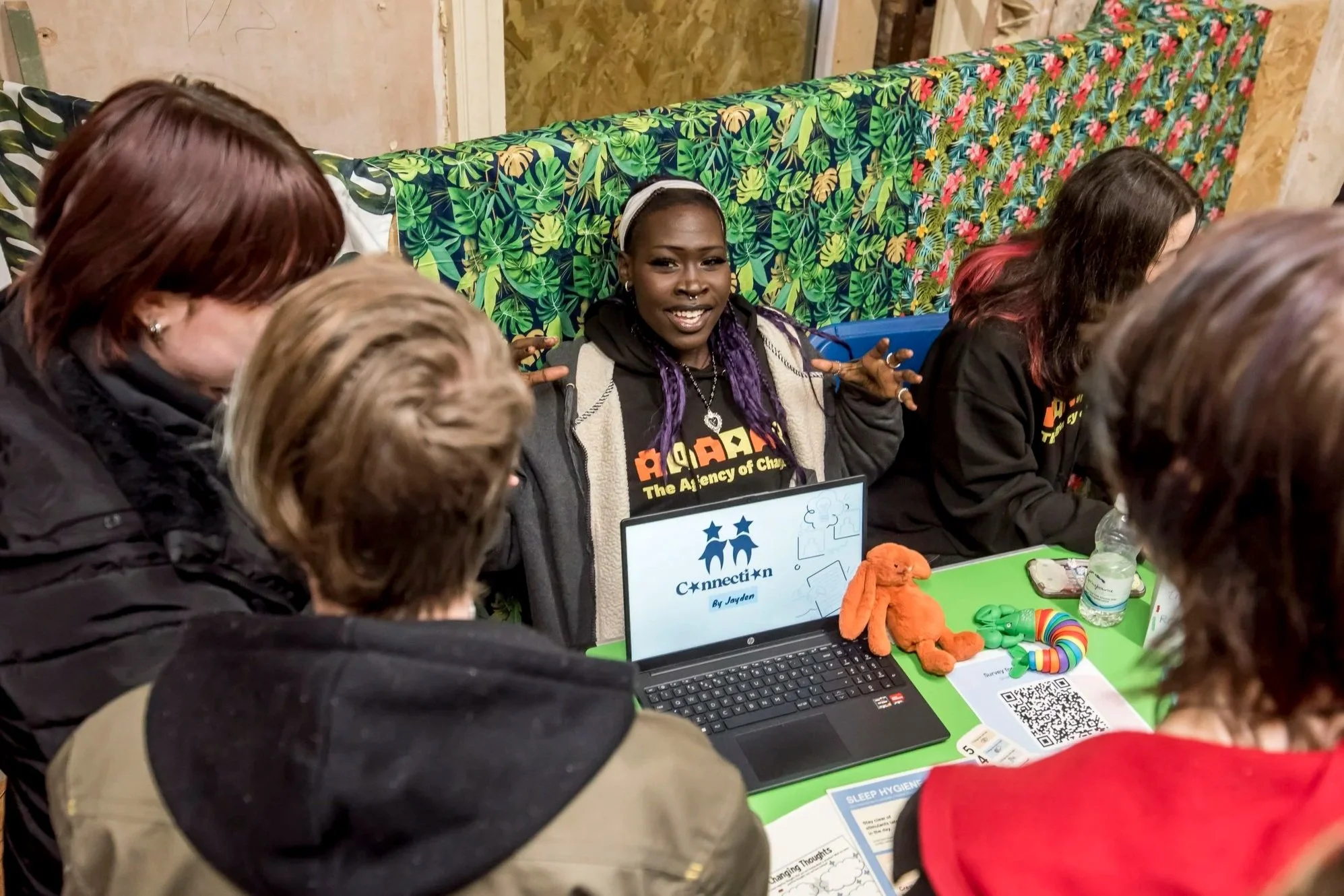

In a world of significant change and transformation, economic growth does not mean prosperity for all. As a potential way forward, the concept of degrowth invites us to rethink how growth can be better for ourselves, our environment and our communities. The Agency encourage social innovation through supporting young people from underserved communities to develop projects rooted in local assets, lead change in their communities and drive sustainable futures.